

History
A century+ of art
"Tea at the River Walk" by Elaine Bornemeier

VISIT US
130 King William Street
San Antonio, TX 78204
Tuesday – Saturday: 10am – 3pm
Sunday: Closed
Monday: Closed
Admission is always free!
Starting with a vision
On March 13, 1912, a group of San Antonio artists and art enthusiasts founded the San Antonio Art League with three goals: give working artists a place to exhibit, build a collection the public could enjoy for free, and establish an art school. Every one of those goals has outlasted its founders. More than a century on, SAAL+M is still free, still volunteer-run, and still doing all three things.
Decades without a home
What's easy to forget, looking at SAAL+M's handsome King William building today, is that the organization spent most of its history without a permanent address. In 1926 the Art League began a partnership with the Witte Museum, sharing exhibition space there for 45 years. A year later, in 1927, that alliance let the League finally open its long-planned art school.
World War II broke the momentum. In early 1942 the school closed "for the duration," a casualty of a country focused elsewhere. It was the generosity of one woman that kept it alive: Marion Koogler McNay, a wealthy arts patron and graduate of the Art Institute of Chicago — who would go on to found the McNay Art Museum — offered the League space in an aviary on her own estate so classes could continue.
After the war, the League kept moving. It spent time at the Belgian Pavilion at HemisFair Plaza, a leftover structure from San Antonio's 1968 World's Fair, before relocating to the Koehler Cultural Center — the former mansion of the Otto Koehler family, which had been donated to San Antonio College, whose leadership invited the Art League to office there. It wasn't until 1987 that the League purchased a home of its own: a converted nineteenth-century carriage house at 130 King William Street. Through the generosity of donors, the mortgage was paid off within two years, an occasion the membership celebrated with a "burning the mortgage" party.

In an example of how SAAL+M is driven by community support, the current building was purchased in 1987, and generous donors paid off the mortgage in just two years.
A wildcatter's wildflowers
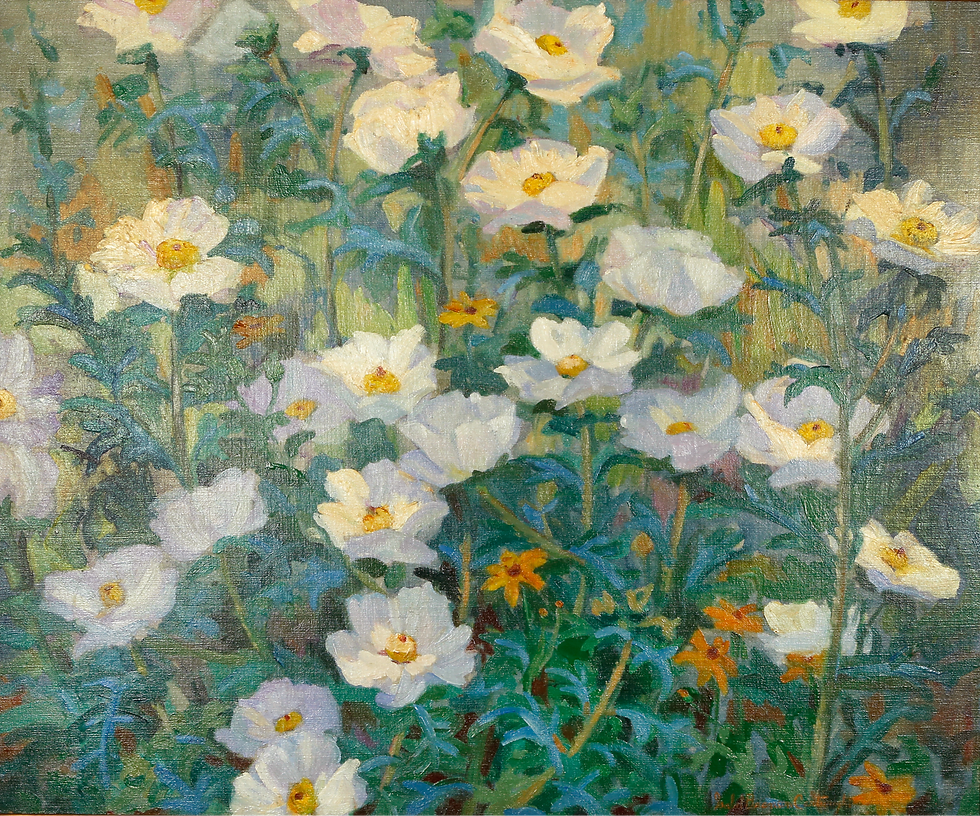
SAAL+M's best-known holding, the Davis Collection, has an origin story almost as improbable as the building's. In 1927, the eccentric oil wildcatter and philanthropist Edgar B. Davis approached the Art League with an idea: a national juried painting competition, with substantial cash prizes, open to any artist willing to come paint Texas wildflowers and Texas life. It was a novel concept at the time — the purchase-prize format would later be copied by arts institutions elsewhere — and it worked. Word spread quickly from Texas to New York to California, and for three springs running, the Texas Wildflower Competitive Exhibitions filled the newly opened Witte Museum with more than 300 paintings, drawing thousands of visitors and touring as far as New York.
Each year, Davis personally purchased the winning paintings and donated them to the Art League. When his attention (and his money) eventually moved elsewhere in 1929, the competitions ended — but the donated paintings stayed, forming the seed of what is now the Davis Collection: a genuinely national gathering of early-twentieth-century regionalist art, including work by founding members of the Taos Society of Artists, that happens to have Texas as its unifying subject.

Edgar B. Davis (pictured above) funded a national juried painting competition that brought in works from artists across the country. His purchases of winning pieces formed the foundation for the Museum's permanent collection.
Continuing traditions
The Davis Competitions ended in 1929, but they set something in motion that never really stopped. SAAL+M's Annual Juried Artists Exhibition grew directly out of those shows and has run, in one form or another, ever since — making it one of the longest-running art competitions in Texas. Since 1946, the exhibition's top prize, the Julian Onderdonk Memorial Purchase Prize, has added a new work to the permanent collection each year, meaning the collection has been growing by a juried, curated addition annually for nearly eighty years. Since 2001, the League has also presented the Ethel T. Drought Founders Award each May, recognizing a patron whose support has made a lasting difference for the arts in San Antonio.
Building a museum, not just a home
Owning a building in 1987 didn't finish the story — it started a new chapter of shaping that building to serve art. Interior walls came down in the early 1990s to create real gallery space. In 2007, the Haysbridge Sculpture Garden transformed the front and side yards into a home for the League's permanent and members' sculpture. In 2017, a Semmes Foundation grant funded the remodeling of the studio building into the Semmes Studio, now a working classroom for artists teaching artists. And in the fall of 2020, decades after Edgar Davis first funded those wildflower prizes, the collection he started finally got a gallery built specifically for it: the Educational Gallery for the Edgar B. Davis Collection of Texas Art, made possible by Amy Shelton and the V.H. McNutt Memorial Foundation, and championed for years by SAAL+M's own Lyn Belisle Kurtin and William Kurtin.
Today the permanent collection includes more than 600 works — up from roughly 300 in 1990 — by artists including Robert and Julian Onderdonk, José Arpa, Emma Richardson Cherry, E. G. Eisenlohr, Martha Mood, Charles Umlauf, and Amy Freeman Lee. SAALM's own institutional archive, meanwhile, has finally come out of storage too: a research library, assembled by longtime board member Ilna Colemere out of a former upstairs kitchen, now holds board minutes and yearbooks back to 1945, part of Edgar Davis's own personal book collection, and photographs tracing SAAL+M's many homes all the way back to its first meeting at the old Carnegie Library — now the Briscoe.
What hasn't changed, through the moves, the war, the decades of borrowed space, is the thing the founders wrote down in 1912: a place for artists to show their work, a collection for the public to enjoy, and none of it behind a paywall. That's still the whole idea.